
A ₹80 Cr company often runs on finance built for a ₹10 Cr one. Here is what a virtual CFO actually does for scaling Indian businesses, and when you need one.
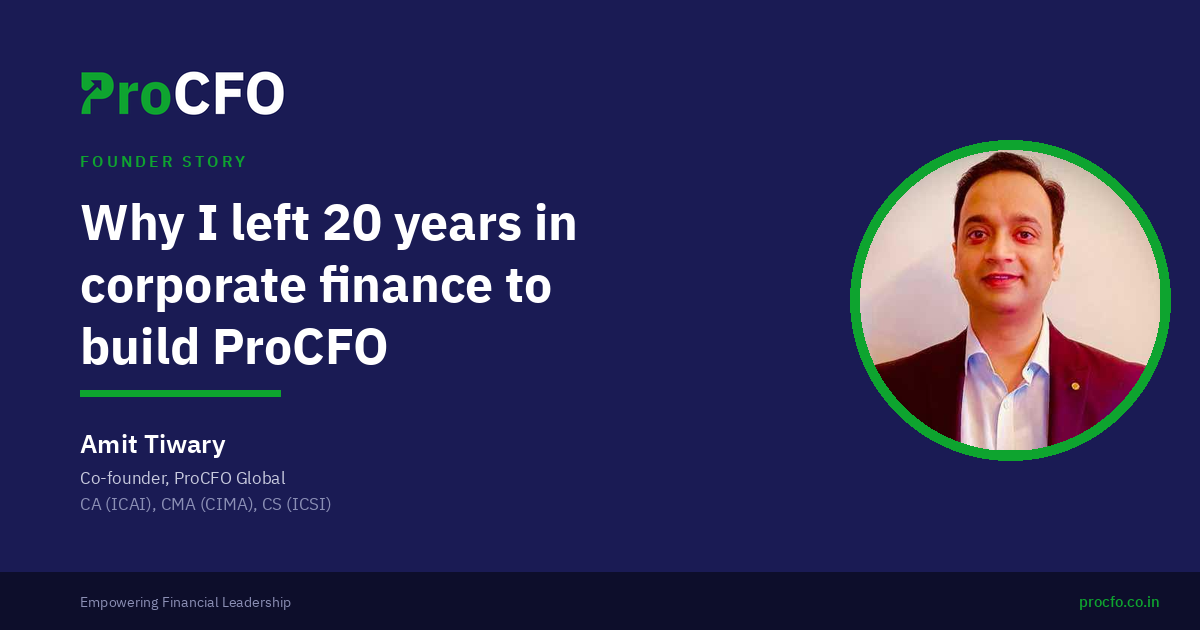
A ₹300 Cr company has a CFO, an FP&A team, and a treasury desk. A ₹80 Cr company, growing just as fast, usually has a CA who files returns and a founder running the entire finance strategy out of his own head. For 20 years, I worked on the wrong side of that gap. This is why I left.
The gap nobody was sitting in
I spent two decades building finance functions inside large corporates. Budgets, models, board decks, fundraises, the full machinery. The work was good. But those companies already had everything. They had the people, the systems, the senior eyes on every number. They were never the ones who needed me most.
Then the calls started coming from a different kind of founder. People running strong, profitable, fast-growing businesses doing ₹40 Cr, ₹80 Cr, ₹100 Cr. Scaling hard toward the next stage. And every one of them was making ₹100 Cr decisions on finance infrastructure built for a much smaller company.
Their CA was handling compliance. Nobody was handling strategy. That is the gap. It does not sit at the bottom of the market, with businesses that cannot afford finance. It sits in the middle, with businesses that have outgrown their compliance setup but cannot yet justify a full-time CFO at a crore a year.
What that gap actually costs
This is the part founders underestimate. The cost of the gap is not survival. These are not failing businesses. The cost is the difference between scaling sharply and scaling expensively. Here is what I kept finding when I looked under the hood of companies in this range.
Decisions made on gut feel, not a model
Hiring plans, pricing changes, a new branch, a new product line. Big capital decisions taken because they felt right, with no model showing what they do to cash 12 months out. At ₹10 Cr you can carry that in your head. At ₹80 Cr you cannot, and the mistakes get expensive.
Financials that are clean for tax but not for a boardroom
The CA delivers statements that satisfy the ROC and the income tax department. That is compliance, and it matters. But the same numbers are nowhere near ready for a bank credit committee or an investor data room. When the fundraise or the banking line arrives, the scramble begins.
Margins that leak where no one is looking
Top-line margin looks healthy. Underneath, at the unit or product or client level, money is leaking, and no one senior enough is watching the right cut of the data to catch it. A business can grow revenue for two years while its real margin quietly erodes.
Cash visibility that stops at 30 days
Compliance is backward-looking by design. It tells you what already happened. A scaling business needs to see cash and working capital 60 to 90 days forward, because that is the window in which you can still do something about a problem.
What good finance leadership looks like at this stage
The fix is not a bigger accounts team. It is a different layer entirely. Strategic finance sits above compliance and answers a different question. Compliance asks whether you are filing correctly. Strategy asks whether you are allocating capital correctly, pricing correctly, and growing in a way the balance sheet can sustain.
That layer is what a virtual CFO provides. The same rigour a ₹300 Cr company gets from its full-time CFO, delivered to a business scaling from ₹40 Cr toward ₹250 Cr, without the cost of a senior full-time hire. FP&A, MIS that a board would accept, capital allocation, investor and lender reporting, and someone accountable for the numbers who is not also the person filing them.
How we approach it at ProCFO
I started ProCFO to put that layer within reach of the in-between business. We are not an audit firm, which matters more than it sounds. It means we can run a company’s finance operations and its finance strategy at the same time, with no independence conflict. Most large firms cannot do both for the same client. We can.
The pattern repeats across the businesses we see. A promoter who knows the top line by heart but has never seen contribution margin by product. A board reviewing numbers six weeks after the month has closed. A strong company flying without an instrument panel. The work is rarely a rescue. It is giving a good business the visibility it should have had a stage ago. Ambition deserves infrastructure. You should not have to wait until you are a giant to run finance like one.
Frequently asked questions
What does a virtual CFO do in India?
A virtual CFO provides senior finance leadership on a part-time or retained basis. The role covers FP&A, MIS and management reporting, cash and working capital planning, capital allocation, and fundraise or lender readiness. It is the strategic layer that sits above your CA and accounting team, not a replacement for them.
When should a growing company hire a virtual CFO?
The clearest signal is when you are making large decisions without a model behind them, or when your financials are clean for tax but not ready for an investor or a bank. For most Indian businesses this stage arrives somewhere between ₹40 Cr and ₹250 Cr in revenue, when the finance function has not kept pace with growth.
What is the difference between a virtual CFO and a full-time CFO?
A full-time CFO is a single senior hire, often costing around ₹1 crore a year all-in, dedicated to one company. A virtual CFO delivers the same strategic capability on a retained model for a fraction of that cost, which suits businesses that need the expertise but cannot yet justify the full-time salary.
Is a virtual CFO only for companies in trouble?
No. The strongest use case is a profitable, growing business that wants to scale well rather than fix a crisis. A virtual CFO is an upgrade to your decision-making, not a rescue operation.
If this sounds familiar
If your business has outgrown its compliance setup but is not yet ready for a full-time CFO, that in-between stretch is usually where the most expensive mistakes get made. The fastest way to see where you stand is a short Virtual CFO assessment. Reach us at info@procfo.co.in, or message CFO READY on LinkedIn.
Amit Tiwary is Co-founder of ProCFO Global Private Limited. CA (ICAI), CMA (CIMA), CS (ICSI), with 20+ years in corporate finance.